 |
Michigan Womyn's Music Festival
Aug. 8 - 13, 2000 A Taste of What We Know is Possible |
What's a Festival Without a Controversy?
Sidebar to accompany Festival review article
|
Michigan Womyn's Music Festival
Aug. 8 - 13, 2000 A Taste of What We Know is Possible |
What's a Festival Without a Controversy?
Sidebar to accompany Festival review article
Edwina Lee Tyler |
It's the opening celebration of the 25th annual Michigan Womyn's Music Festival. A crowd of thousands, constituting the largest city in Oceana County for this one week each August, gathers under sunny skies and star-splashed nights to recognize the familiar and encounter the outrageously uncommon.
It's a community that knows that feminism is no more dead than sexism is. It's women and girls who don't see the truth of their lives reflected in mainstream culture but see themselves here on stage.
To my left is a barefoot woman in a tie-dyed caftan. To my right is a woman in motorcycle boots whose lovers call her daddy. As vocal impresario Rhiannon growls "I do not know what I look like any more," a river of women from 80 to infancy streams off the stage into the audience. They're met at the bottom of the ramp by a Harley Davidson delivering Lynn Breedlove of punk rock band Tribe 8. Breedlove takes the stage and shouts out to "growly old ladies and pierced baby dykes/ finding out we're much less different than alike." Everyone I see is blinking back tears.
At the close of the Festival, women's music icon Ferron will debut a new composition, written for Michigan, that gives voice to what's going on here: "I am home. Tonight I'm happy in my skin."
Before the Festival opened on August 7th, the line of women waiting to get in was a tail gate party five miles long. Arriving in RVs, compact cars, baby strollers and on bikes, the crowd of close to 7,000 was made up of old timers and over 2,500 "festi-virgins" who had heard the legend and had to see it for themselves. They came for camping and community, dishing and dancing, and to be a part of what Tribe 8 calls "the best show in the whole world."
Surprise guests the Indigo Girls told the opening night crowd, "We wanted to come back so bad this year that we invited ourselves. We were like, can we please come back?"
 The Indigo Girls joined a line up of over 40 performances that demonstrated the contemporary relevance of a cultural wave that began as the sound track for the women's liberation movement of the 1970s. Toshi Reagon, whose thundering set closed the Festival's evening concerts on Saturday night, paid homage to Holly Near, who played the first Michigan Festival. "We've got our young people today, our young women poets, writing about 'Yo, yo, yo, I'm a woman and I know that you try to oppress me, but don't mess with me.' Holly Near was saying the same thing back in the day when no one else had said it."
Near and other long-time Festival favorites were joined by Gen X artists like Melissa Ferrick, Catie Curtis and Kinnie Starr. Ferrick, who thanked her fans for the letter writing campaign that brought her to the attention of Festival organizers, paid homage to "Ferron and the Indigo Girls and all of my heroes who are here for including me in such a beautiful, beautiful thing."
The week of performances began with a theatrical double header on Tuesday night's Acoustic Stage. Holly Hughes, in Preaching to the Perverted, and Marga Gomez, in jaywalker, brought high energy and humor to their one-woman depictions of lesbian artists colliding with societal constraints.
Later in the week the Acoustic Stage hosted a series of rousing dance performances, including Friday night's world premiere of Dance Brigade's Cavewomen. The audience responded to the troupe's exuberant slip-and-slide finale like a cork flying out of a bottle of champagne.
Fueled by non-stop perfect weather, Friday's energy level continued to soar through sizzling Night Stage sets by the Latin American All Stars and former Sweet Honey in the Rock diva Evelyn Harris before an astonishing twelve minutes of world-class fireworks kicked off the final set's multi-generational mosh pit.
Day Stage favorite Kinnie Starr echoed the sentiments of many performers and festi-goers alike when she described her first year at Michigan: "I'd never seen anything like this in my life, obviously, because nothing else exists like this!"
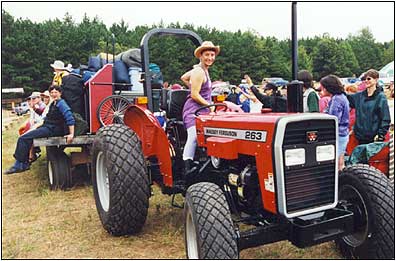 There's no doubt, there's plenty to look at. Besides the performances, film festival and workshops on the official program, there's the people-watching. Women festooned in full body paint. Children freed from rules like "don't talk to strangers." No-longer-modest women with sunburns on skin that's usually hidden. Barbie dolls in outfits representing every flavor of festi-goer installed in campsite shrines. Dozens of women, fast becoming friends, on striped-awning, tractor-pulled "cross-town" surreys.
But this is no place for passive observation. Michigan's magic is in the simultaneous contributions of thousands of women and girls who together create the experience of the Festival.
Over 1,500 festi-goers take part in the preparation of almost 100,000 meals - from pasta putanesca to the perennial favorite, burrito night - that are cooked over open fire pits. A worker community of 600 builds stages, lays down carpet to improve wheelchair accessibility and loves more than 300 children in four different child care programs. Hundreds of women offer workshops ranging from Archery to Female Ejaculation that get women talking about - and trying - things they'd scarcely imagined.
Says festival mainstay Judith Casselberry, "We have here a little taste of what we know is possible. For the week that we're here, we get that."
And lest we take ourselves too seriously in this grand endeavor, comedians Suzanne Westenhoefer and Elvira Kurt are on hand to point out the absurdities of life on the land, like the feminization of the ubiquitous Porta-Janes.
Talk to the performers and it becomes clear that this is a place deeply committed to women's creativity. According to Krissy Keefer, founder of the Wallflower Order/ Dance Brigade, "Michigan embodies a profound commitment to the artist; no other festival does it like this one." The all-woman sound, light and stage crews rival the technical excellence of production crews anywhere, according to Michigan performers.
It's a place committed to social change, not just in the world outside, but in the way the Festival itself is produced. Casselberry, who along with Keefer directs the Festival's annual opening celebration, says "As an African American musician, I can say there's no other festival like this out there. We've done years of work to integrate women of color into this festival at all levels, and credit is due on all sides. Now when new women of color come onto the scene, they're chomping at the bit to come back."
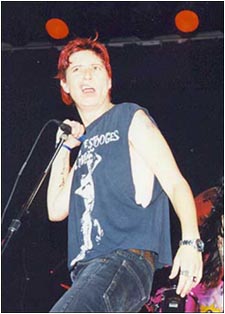 Lynn Breedlove of Tribe 8 |
Holly Near, in a retrospective of women's music on Saturday Acoustic Stage, described the Festival as a space that "allows us to understand who we are apart from male energy, apart from the dominant culture. It has always been essential to have phases of separatism so that deaf people can understand who they are apart from hearing people, that black people can understand who they want to be apart from white people, that women can understand who we want to be apart from men, and the list goes on."
Since its founding, the Festival has come under attack for creating a separate space, however temporary, for women to gather. Says producer Lisa Vogel, who started the Festival when she was 19 years old, "we've always had to explain that it's not about excluding anyone; it's about including women." Today's critique comes not from conservative men but from young "gender activists" who question the validity of the term woman.
About 25 of these activists, calling themselves "Camp Trans," staged a demonstration at the Festival's Main Kitchen on Saturday. [See sidebar.] Festival organizers responded by affirming "Michigan has always been home to women who represent every point along the continuum of gender identity: from butch to femme and beyond butch and femme, including many who consider themselves transgendered. The Michigan Womyn's Music Festival remains clear and firm in our commitment to maintain the Festival as womyn-born womyn space where we gather in celebration of our diverse identities as womyn-born womyn."
Six glorious days and nights and the requisite controversy later, festi-goers are heading home recharged for another year, with Lynn Breedlove's exhortation ringing in their ears, "What you learn here, and what you find here, go out in the world and make it happen out there."
As this village in the woods is dismantled and the raccoons emerge from hiding, thousands of women the world over are heartened by Vogel's promise, "If you all keep coming, we'll keep doing this for another 25 years."
 Registration Forms |
 Performance Schedule |
 Festival Information |
Discussion Forums |
 Home Page |
 Ticket Information |
 Intensive Workshops |